
Company
CourtReserve
An AI-enabled operating model for faster, more consistent product decisions
Role
Head of Product, Player Experience
Overview
At CourtReserve, our product organization faced a familiar scaling problem: the number of teams and opportunities was growing faster than our ability to support them with consistent research, design, and product strategy.
We had eight product squads, only three designers, varying levels of product-management experience, and customer evidence distributed across conversations, support channels, analytics, and individual team knowledge.
The challenge was not simply to make people work faster.
We needed a way to improve the quality and consistency of product thinking across every squad without creating a larger centralized process or adding unnecessary overhead.
The answer was an AI-enabled product operating model built around a simple principle:
Human-led. AI-accelerated.
Metrics
8
Product squads using the system
30
+
Product initiatives supported
16
Agentic product-development skills
The Challenge
Product capacity was scaling faster than product practice
As CourtReserve grew, eight squads were working across a broad mix of customer needs, platform improvements, new capabilities, and strategic initiatives.
But the supporting product infrastructure had not scaled at the same rate.
Three designers supported eight squads. Product managers had different levels of experience and different approaches to discovery and definition. Customer evidence existed across support conversations, interviews, analytics, sales feedback, product usage, and institutional knowledge.
That created several risks:
Teams could move into solution development before a problem was well understood.
Similar research could be repeated across squads.
Important customer evidence could remain trapped inside individual conversations or teams.
Design capacity could become a bottleneck.
And the quality of product definition could vary depending on the experience of the individual PM.
The opportunity was to build a shared way of working that increased product maturity across the organization without introducing a heavy process.
”We needed a way to improve the quality and consistency of product decisions without adding a heavy process or significantly expanding the team.
My Role
Designing the operating model, not just using the tools
As Head of Product, I was responsible for improving how the product organization moved from customer problems to validated solutions.
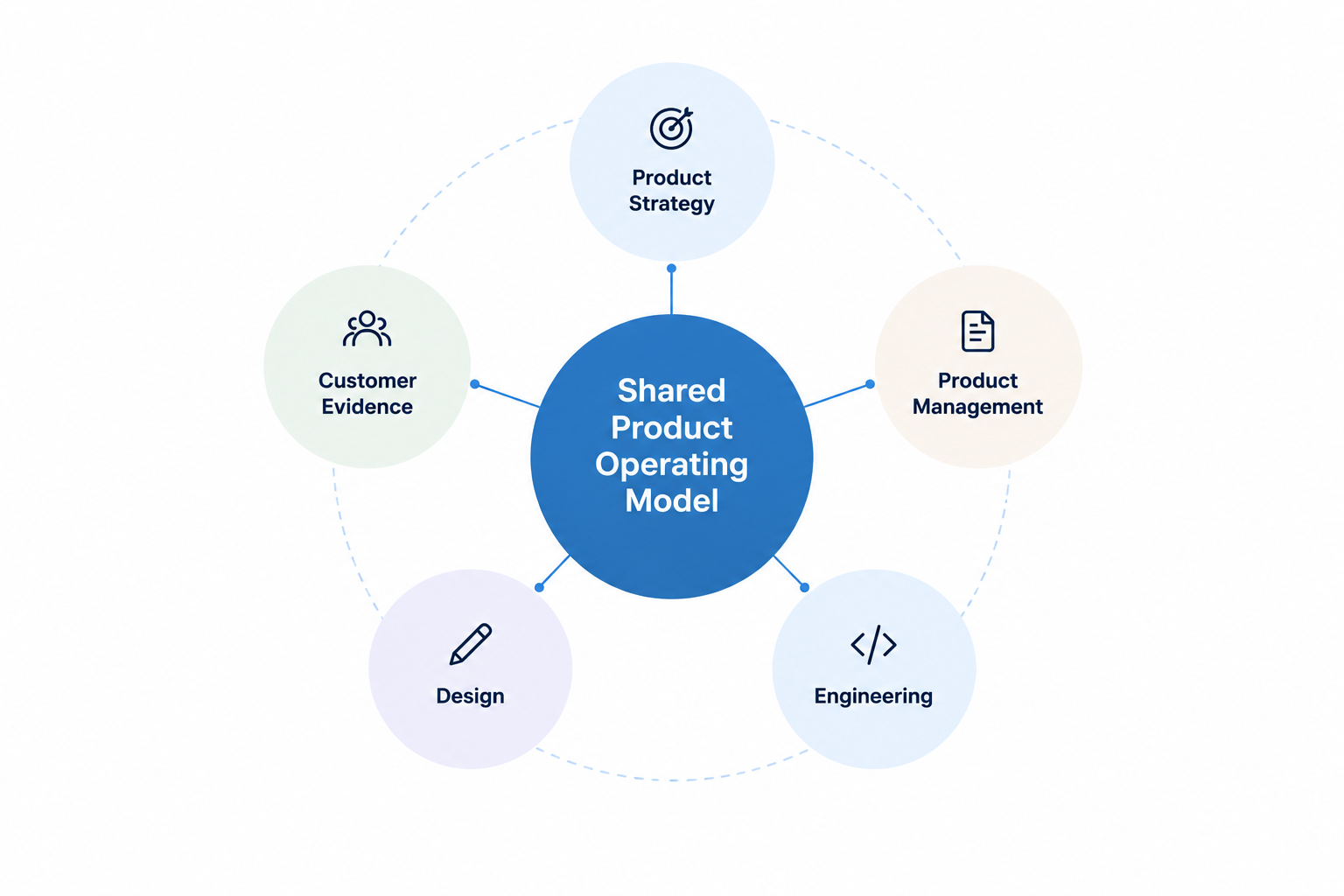
I identified the organizational constraint and helped architect a new operating model that connected customer evidence, product planning, design, and delivery.
The model was developed collaboratively. I focused heavily on the planning, definition, prototyping, and delivery workflows, while a colleague led much of the evidence architecture and developed many of the agentic skills that powered the system.
That distinction mattered.
The goal was not to automate product management or replace judgment. It was to use AI to give every product manager and squad better access to evidence, stronger starting points, and faster feedback loops.
The Operating Model
Human-led. AI-accelerated.
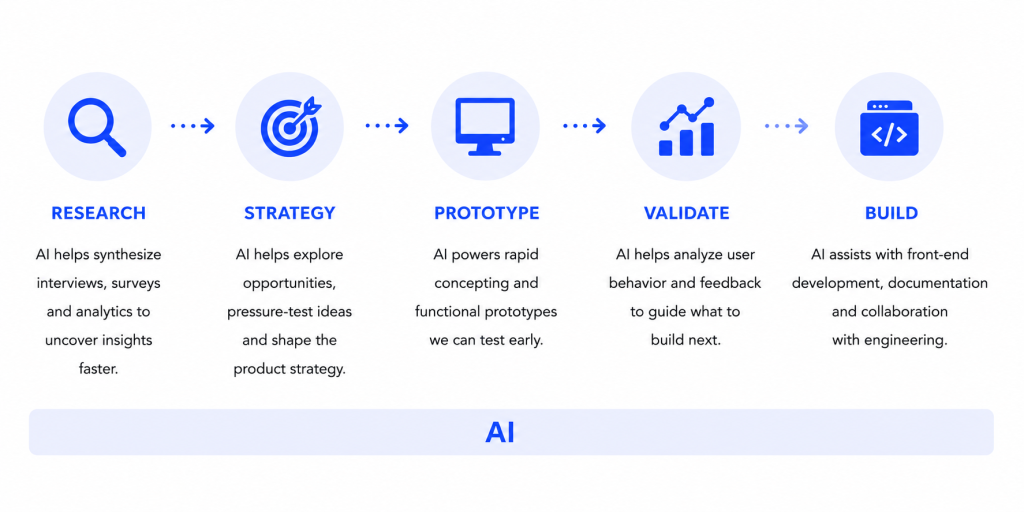
We organized the product-development process into five connected stages:
Research → Strategy → Prototype → Validate → Build
AI operated as a layer across the entire workflow rather than as a single step.
Human judgment remained responsible for deciding which problems mattered, evaluating tradeoffs, understanding context, making strategic choices, and determining what should ultimately be built.
AI helped teams process information, identify patterns, generate structured starting points, explore alternatives, and move between stages with less manual friction.
The result was not an automated product process.
It was a product organization with more leverage.
Research
Making customer evidence easier to access
- Customer evidence was scattered across research, support, feedback, analytics, and other customer-facing sources.
- AI-assisted workflows helped bring those inputs together so teams could start with a broader view of what the organization already knew.
- This reduced duplicated discovery work and helped squads focus deeper research where it was actually needed.
Strategy
Turning evidence into shared understanding
- Teams needed a more consistent way to identify patterns across customer needs, behaviors, pain points, business context, and product data.
- AI-assisted synthesis helped organize qualitative information, surface recurring themes, and identify areas that required deeper investigation.
- Product managers remained responsible for interpreting the evidence, weighing tradeoffs, and deciding what mattered.
Prototype
Moving from insight to something teams could react to
- Limited design capacity made it difficult to explore every concept through a traditional design process.
- AI-assisted prototyping helped teams move quickly from a product hypothesis to a functional experience that could be reviewed and tested.
- This shifted conversations from abstract requirements to tangible product ideas, while allowing designers to focus on the highest-value experience problems.
Validate
Creating faster feedback loops
- Teams needed to know whether an idea was solving the right problem before committing significant engineering effort.
- AI-supported analysis helped teams organize customer feedback, behavioral signals, and validation findings more quickly.
- This made it easier to refine requirements, challenge assumptions, and decide what to change before moving into full delivery.
Build
Reducing the distance between product intent and implementation
- Translation between product, design, and engineering could introduce ambiguity and slow delivery.
- Structured requirements, working prototypes, and shared design-system patterns gave engineering a clearer understanding of both the problem and intended experience.
- AI-assisted workflows supported documentation, edge-case exploration, and implementation planning, helping teams move from validated ideas to working software with less friction.
AI accelerated the work. Human judgment made the decisions.
What Changed
Adoption
All eight squads adopted the model, every product manager used the shared workflows, and more than 30 initiatives moved through portions of the system.
Speed
Work that could previously take weeks to move from scattered evidence to validated requirements could often move in days.
Consistency
PMs started from stronger evidence, designers focused limited capacity on higher-value problems, engineering received clearer product intent, and every squad adopted the shared design system.
The larger outcome was organizational leverage.
AI did not eliminate the need for experienced product managers, designers, researchers, or engineers. It helped a relatively small product organization apply those capabilities more consistently across more teams and initiatives.
What I Learned
AI changes the leverage of a product organization
The most important lesson was not that AI could generate requirements, summarize research, or create prototypes.
Those capabilities were useful, but they were not the transformation.
The transformation came from connecting them into a coherent operating model.
When AI is embedded thoughtfully across research, strategy, prototyping, validation, and delivery, it can reduce low-value friction while giving teams more time for judgment, customer understanding, strategic thinking, and collaboration.
The model reinforced a principle that now shapes how I think about AI and product leadership:
The goal is not to automate the product-development process. It is to increase the leverage of the people responsible for it.
